 |
The Ukrainian flag is raised in front of Danish Parliament in Copenhagen, Denmark, on March 3. |
When Denmark became the first liberal democracy to tell Syrian refugees to return to their war-torn home in 2019, Russian jets were still dropping missiles in Syria, in an effort to help President Bashar al-Assad's regime regain control of the country.
Ukraine is now being pummelled by the same Russian military, forcing more than 2.2 million people to flee to neighboring countries, according to the United Nations.
But instead of being met by xenophobia, detention centers and threats of repatriation in the European Union, Ukrainian refugees are being welcomed by European nations like Denmark with open arms.
"When there is war in Europe and a European neighbor is exposed to what we see in Ukraine, there is not the slightest doubt in my mind: We must help as best we can ... by welcoming Ukrainians on Danish soil," said Mattias Tesfaye, the Danish minister for foreign affairs and integration, soon after Russia invaded Ukraine in late February.
The Danish government is drafting legislation that will suspend asylum rules for Ukrainians, Rasmus Stoklund, the foreign affairs spokesperson for Denmark's ruling Social Democratic Party, told CNN.
"They won't be part of the asylum system," Stocklund told CNN. Instead the proposed law will make it easier for Ukrainians to receive residency permits "so they can quickly start in school, on an education or in a job," according to a statement by the Danish immigration and integration ministry.
This would be in line with the European Union granting temporary protection for Ukrainians, allowing them to enter the bloc without a visa and to choose which country to go to.
Those eligible would be given protected status -- similar to that of a refugee -- in any EU country for a one-year period, which may be reviewed in future. This is a stark contrast with the EU's asylum rules where refugees must ask for asylum in the first member state they entered. Efforts by the EU to reform this system and help to equitably resettle asylum-seekers around the bloc have been unsuccessful.
But critics are accusing the Danish government of hypocrisy, since it is currently urging Syrian refugees originating from Damascus and its surrounding countryside to return there, despite the ongoing civil war and the regime's brutal reputation.
While fighting has subsided considerably in the region around Damascus, activists say the Danish government is actively putting Syrians in harm's way.
In a statement to CNN, the Danish Ministry of Immigration and Integration Affairs said all refugees were treated the same. "Regardless of the law on temporary residence permits for persons expelled from Ukraine, all persons applying for asylum in Denmark have the same rights in the Danish asylum system."
It added that about 30,000 Syrians who have been granted a residence permit in Denmark since 2014 still live in the country.

Demonstrators march with a banner reading "Syria is not safe" during a protest against the government's policy of returning some Syrian refugees in Copenhagen on November 13, 2021.
But Michala Clante Bendixen, the head of Refugees Welcome Denmark, which advocates for a streamlined asylum system, said the disparity in treatment suggests the government places a higher value on White lives.
Bendixen said the 2015 migrant crisis had shown that: "If people arrive from Afghanistan or Syria, they will be met with suspicion, they will be called migrants until they [gain] refugee [status]. But now we immediately call Ukrainians refugees. What's the difference?
"It's so disappointing and so terrible that people are so limited in their empathy with other human beings in the world," she added.
Punitive policies
Syrian-born siblings Dania and Hussam, who integrated fully into Danish society after arriving in the country as refugees in 2015, have been caught in Denmark's anti-immigrant dragnet, say campaigners.
The pair, now in their 20s and fluent Danish speakers, have spent the past year in limbo, after Danish authorities decided not to extend their father's residency permit, which their own visas are linked to. They are appealing the decision.
Last year, the siblings told CNN they feared that if they had to return to Syria, they could be punished for "turning our backs" on the regime. Hussam also risks being conscripted into the Syrian army, he said.
An estimated 600 of the more than 35,000 Syrian refugees who traveled to Denmark have been stripped of their residency status by immigration authorities, Bendixen says.
While the Danish government cannot repatriate Syrians as it does not have diplomatic relations with Syria, it aims to compel them to leave by making Denmark as inhospitable a place as possible to live in, and covering their travel costs to return, say asylum experts.
In 2021, Tesfaye, the Danish minister for immigration and integration, defended the policy in a statement to CNN, saying that "Denmark has been open and honest from day one" that residence permits for Syrian refugees are "temporary, and that the permit can be revoked if the need for protection ceases to exist.
"The approach of the Danish government is to provide protection to those in need of it, but when the conditions in their home country have improved, former refugees should return to the home country and reestablish their life there," Tesfaye added.
Those who have exhausted all legal avenues to appeal their lost residency status face being sent to deportation facilities, which Bendixen describes as open-air prisons designed to break people down.

The centers are partially open, which means that occupants are able to move in and out freely, but they have to check in every evening, have no income, and no right to work or study. One such center is around four miles from the nearest bus stop, making practically impossible for anyone to leave.
The move is just one of a number of policies by Danish authorities that appear to target the country's non-White immigrant community, critics say.
In 2019, the government began to control where immigrants lived by forcing social and ethnic change in 15 low-income housing estates across the country. Authorities described them as "hard ghettos," and are defined by Danish regulations partly according to the races of residents.
And as Syrians braved treacherous journeys to reach the safety of Europe, a so-called jewelry bill was rolled out in 2016, allowing the government to take certain assets from asylum-seekers to contribute to the country's welfare state.
"We might as well be honest about the fact that we would rather help Ukrainian refugees than Somalians and Palestinians," The former Liberal Party immigration minister Inger Stojberg, whose party pushed through the so-called jewelry bill, wrote on Facebook on Wednesday. "No one dares to say it like it is: It's because the Ukrainians are more like us and because they are primarily Christians."
Stoklund, foreign affairs spokesperson for the ruling Social Democratic Party, told CNN the jewelry law will not apply to Ukrainians as they will not be part of the asylum system if the draft legislation is approved.
That opt-out is "unfair," according to Bendixen, especially considering the financial burden other non-European refugees face in trying to reach safety. "Ukrainians can just travel as tourists into Europe," since they have enjoyed visa-free status in the EU since 2017.
"They don't need human smugglers," she explained. "They don't need to risk their lives on small sinking boats or in the desert to travel safely to Europe ... they will not have to go through the asylum system -- which is very slow and can easily take a year before you get your case decided."
Despite this, descriptions of Ukrainian refugees from politicians and in the media could not be more different to the chaotic response to the 2015 migrant crisis driven largely by the Syrian civil war.
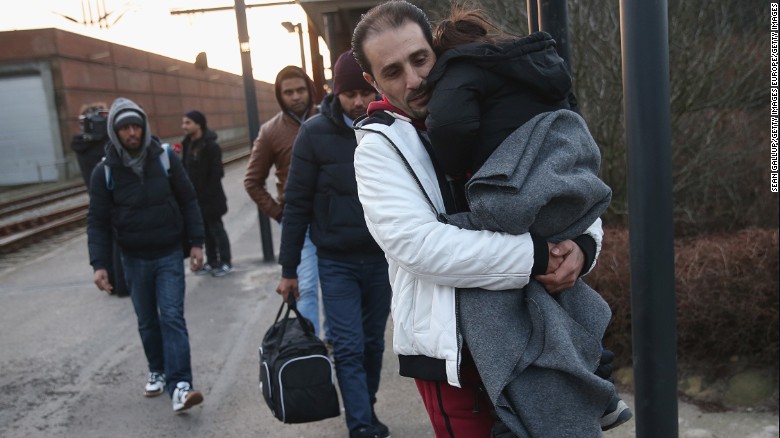
"Part of the answer has to do with identity," wrote migration and asylum expert Lamis Abdelaaty on Twitter. "Ukrainians are seen as White, Christian. Syrians, Afghans, and others are not perceived this way. People sympathize with refugees who they think share their race, religion, etc."
"But identity is not the whole story," said Abdelaaty, an assistant professor at Syracuse University in the US state of New York. "There is a foreign policy dimension to this too. It matters that Ukrainians are fleeing a Russian invasion. Welcoming them is another way for European countries to condemn Putin and to powerfully signal which side of the conflict they are on."
The 2015 migrant crisis saw an estimated 1 million asylum-seekers enter Europe. They were greeted by a skeptical press, a rise in anti-migrant policymaking -- as seen in Denmark -- and a rise in support for far-right parties, following a series of ISIS terrorist attacks over the following year.
"And, now, suddenly, even more people are arriving in two weeks and everybody's like: 'Oh, yeah, we can handle it and we have lots of space and they should be welcome,'" Bendixen said.
As Russian airstrikes become more indiscriminate, the United Nations said Tuesday that the outflow of Ukrainian refugees hit 2 million as mainly women, children, and the elderly seek refuge from the unprovoked aggression. Those numbers are expected to swell as attacks intensify on a number of key cities and towns.
The response to Russia's invasion of Ukraine shows that countries like Denmark can take in refugees with compassion. The color of a refugee's skin, or their religion, should not have any bearing on that response, activists say.

