Showing posts with label Belarus. Show all posts

Friday, October 7, 2022

Human rights advocates from Russia, Ukraine and Belarus share Nobel Peace Prize


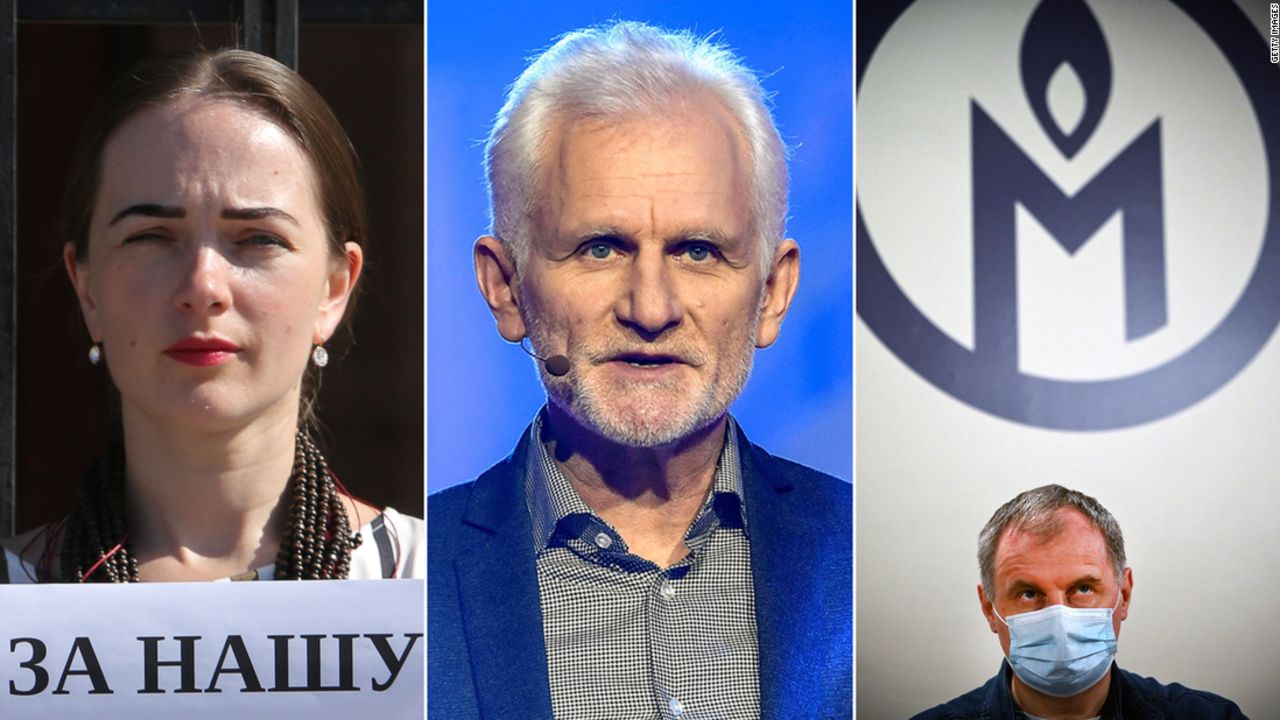
Human rights groups from Russia and Ukraine – Memorial and the Center for Civil Liberties – have won the Nobel Peace Prize for 2022, along with the jailed Belarusian advocate Ales Bialiatski.

The new laureates were honored for “an outstanding effort to document war crimes, human right abuses and the abuse of power” in their respective countries. “They have for many years promoted the right to criticize power and protect the fundamental rights of citizens,” the Norwegian Nobel Committee said.

Their win comes seven months after Russia waged a full-scale war on Ukraine, with the assistance of Belarus. That ongoing conflict loomed heavily over this year’s award, and it had been speculated that the committee would seek to pay tribute to activists in the affected nations.

The Ukrainian group, Center for Civil Liberties, has “engaged in efforts to identify and document Russian war crimes against the Ukrainian civilian population” since the invasion was launched in February, the committee said.

“In collaboration with international partners, the center is playing a pioneering role with a view to holding the guilty parties accountable for their crimes.”

The head of the Center for Civil Liberties said the group was “proud” to win the prize, calling it “a recognition of work of many human rights activists in Ukraine and not only in Ukraine.”

Oleksandra Matviichuk, the organization’s head, said on Facebook she was “happy” that the Center had received the prize “together with our friends and partners.”

She also called for the creation of an international tribunal to prosecute Russian President Vladimir Putin and Belarusian President Alexander Lukashenko for war crimes.

Matviichuk also said Russia should be “thrown out” of the UN Security Council for what she called “systemic breaches of the UN Charter.”

Memorial was founded in 1987 and, after the fall of the Soviet Union, became one of Russia’s most prominent human rights watchdogs. It has worked to expose the abuses and atrocities of the Stalinist era.

The group was shut down by Russian courts in the past year, in a major blow to the country’s hollowed-out civil rights landscape.

Bialiatski, meanwhile, has documented human rights abuses in Belarus since the 1980s. He founded the organization Viasna, or Spring, in 1996 after a referendum that consolidated the authoritarian powers of president and close Russian ally, Lukashenko.

The activist was arrested in 2020 amid widespread protests against Lukashenko’s regime. “He is still detained without trial. Despite tremendous personal hardship, Mr Bialiatski has not yielded an inch in his fight for human rights and democracy in Belarus,” the committee said.

Belarusian opposition politician Sviatlana Tsikhanouskaya congratulated Bialiatski. “The prize is an important recognition for all Belarusians fighting for freedom & democracy,” she wrote in a tweet. “All political prisoners must be released without delay.” 

Ales Bialiatski speaking at the European Parliament headquarters in Strasbourg in 2014.


European Commission President Ursula von der Leyen applauded the “outstanding courage of the women and men standing against autocracy.”

And French President Emmanuel Macron tweeted that the Nobel committee had honored “the unwavering defenders of human rights in Europe.”

“Artisans of peace, they know they can count on the support of France,” Macron added.

It had been widely anticipated that the Nobel decision-makers would focus attention on Russia’s invasion of Ukraine, given its aftershocks in security and stability across the globe.

But those involved in leading military campaigns, such as Ukrainian President Volodymyr Zelensky, were seen as longshots given that government-led peace negotiations appear to offer slim hopes of a resolution to the conflict in the near future.

“The committee is giving a message about the importance of political freedoms, civil liberties and an active civil society as being part of what makes for a peaceful society,” Dan Smith, director of the Stockholm International Peace Research Institute, told CNN. “I think that’s a very important message.”

“This prize has a lot of layers on it; it’s covering a lot of ground and giving more than one message,” he added. “(It is) a prize about citizenship, and what is the best kind of citizenship if we wish to be citizens of peaceful countries in a peaceful world.”

“This year we were in a situation with a war in Europe, which was most unusual, but also facing a war that has a global effect on people all over the world,” Berit Reiss-Andersen, the chair of the committee, told reporters.

Reiss-Andersen said the prize was not intended to send a message to Putin or any other individual. But she added that he represents “an authoritarian government that is suppressing human rights activists.”

The three winners will share the prize money of 10,000,000 Swedish krona ($900,000). The Nobel Prizes will be officially awarded to the laureates at a ceremony on December 10, the anniversary of Alfred Nobel’s death.

source

Thursday, April 14, 2022

Some Belarusians want to fight Russians in Ukraine. They also hope to free their country from Putin's grip


This unit from a Russian ally is training to join Ukraine's army

In a wooded area on the Polish side of the Poland-Ukraine border, men dressed in crisp, clean, camouflage are given tourniquets. They kneel on the muddy ground and start to learn basic survival training.

They call themselves the Pohonia Battalion, a group of fewer than 30 Belarusian exiles living mostly in Poland and other countries across Europe, who hope to join hundreds of their compatriots already involved in the battle for Ukraine.

The aspiring volunteer fighters say that in order to free their country of Russian President Vladimir Putin's grip, he must first be defeated in Ukraine.

At an undisclosed location in Poland, the Pohonia Battalion trains with Kalashnikov replicas.


The group, whose ages range from 19 to 60, carry Kalashnikov replicas. Almost none have fighting experience.

Among them is a professional poker player, a rock musician and an electrician.

They are led by dissident and restaurateur Vadim Prokopiev. "We see a window of opportunity," Prokopiev told CNN on Monday.

"I made the call for Belarusians to join the battle for Ukraine because that's step one before step two, which is the battle for Belarus."

Most of the members, including Prokopiev, were forced to flee their country in 2020, when Belarusian President Alexander Lukashenko -- a Kremlin-backed, Putin ally -- cracked down on a mass protest movement after he claimed victory in a widely disputed election, which was marred by fraud.

"If Ukraine loses this war, Belarus will have zero chance to get free," Prokopiev said. "If Ukraine wins this war that means Putin's hands are too busy and he's too weakened and he won't be supporting Lukashenko with resources."

Pohonia wants to join the International Legion of Defence of Ukraine, a military unit made up of foreign volunteers, but at the time of writing they have yet to be admitted.

Hundreds of other Belarusian volunteers are already on the ground fighting alongside Ukrainian troops. Four have been killed since the start of the war, said Belarusian opposition leader Svetlana Tikhanovskaya.

"The people of Belarus understand that the fate of Belarus depends on the fate of Ukraine and now it's very important to make Ukraine free for it to be easier to get rid of Lukashenko's regime on our soil," Tikhanovskaya told CNN on Wednesday.


Moscow uses Minsk as a satellite base for its unprovoked war on Ukraine. At the start of the conflict, Putin ordered troops into Ukraine through the Russian and Belarusian borders.

Belarus has been used as a springboard for many of Russia's air operations in Ukraine, according to intelligence collected by NATO surveillance planes.

And the Ukrainian military says it has shot down several missiles fired towards its territory from Belarus.

After Russia failed to gain the ground it wanted around Kyiv, forces retreated back into Belarus to regroup and redeploy.

And NATO fears the Kremlin may even call on Lukashenko to deploy his army to bolster Moscow's forces on the battlefield. It's a prospect that would see Belarusian exiles and Minsk's army on opposite sides of the frontline.

The Biden administration has punished Minsk with sanctions targeting Belarusian defense firms, the country's defense minister and has suspended normal trade relations with the country.

But Lukashenko has shown no remorse for his role as a facilitator. "We didn't start this war, our conscience is clear. I'm glad it started," he told reporters in March.

And earlier this week, Putin thanked Lukashenko for his unwavering support, saying, "We never had any doubts that if somebody was to offer their shoulder to us, it would be Belarus." 


Belarus's resistance, fractured and frail since the 2020 crackdown, said volunteer fighters are part of wider efforts to destabilize the Lukashenko regime.

"All those Belarusians fighters are real heroes," Tikhanovskaya said of the volunteers. "Now they are defending Ukraine and maybe one day they could defend Belarus as well," she said, referencing the opposition's wish to see Lukashenko's regime overthrown.

In Belarus, a railway line used by Russian forces to ferry supplies into Ukraine was partially severed by activists in April when Belarusian police opened fire and arrested three men calling it an act of terrorism, according to Belarus state news agency Belta.

And cyber activists recently hacked Belarusian state institutions involved in the war against Ukraine and continue to fight Russian disinformation online, Tikhanovskaya said.

But these small measures have yet to pose any real threat to the 28-year rule of Lukashenko, who is often referred to as Europe's last dictator.

"A long journey starts somewhere so we build a small force to build a bigger force," Prokopiev said.

The exiles now hope that ​Lukashenko's reliance on Moscow ties his future to Putin, and the outcome of what, so far, is a faltering military invasion of Ukraine.

source

Friday, February 25, 2022

How travel is being impacted by the Ukraine invasion


Ukraine's airspace is currently closed in the wake of the Russian invasion.

Ukraine's neighbor Moldova has also closed its airspace, as has part of Belarus. Meanwhile the US government's Federal Aviation Administration has told US pilots to avoid "the entire country of Ukraine, the entire country of Belarus and a western portion of Russia."

The UK has banned civilian Russian aircraft from its airspace. In response, Russia has banned British aircraft from its airspace.

Some commercial airlines, including Lufthansa and Air France, had already suspended flights to Ukraine earlier this week as tensions escalated.

Countries including the United States and the United Kingdom have advised their citizens to leave Ukraine.

The US government issued a travel advisory on February 12 warning against travel to Ukraine "due to the increased threats of Russian military action" as well as ongoing concerns about Covid-19.

The UK government also advises against all travel to Ukraine, explaining that "it is likely that commercial routes out of Ukraine will be severely disrupted and roads across Ukraine could be closed."

The European Union Aviation Safety Agency, known as EASA, has warned of a "high risk" to civilian aircraft flying near the Ukrainian border.

Here's what we know about how travel in Eastern Europe and Russia might be impacted in the wake of the conflict.

Can I still fly to Eastern Europe? 


Air traffic is still moving outside of severely affected areas. As well as bordering Russia, Ukraine also neighbors Belarus, Poland, Slovakia, Hungary, Romania and Moldova, as the map above illustrates.

The European Union Aviation Safety Agency said "operators should exercise extreme caution" and avoid using the airspace within 100 nautical miles of the Russia-Ukraine border.

Moldova has closed its airspace, while Belarus has banned flights over part of the country.

All countries bordering Ukraine were already on the US Centers for Disease Control and Prevention's Level 4 list of highest-risk Covid-19 destinations for travel. The US government also warns against traveling to Belarus and Moldova due to the conflict.

Florida-based travel adviser Gwen Kozlowski, a specialist in travel to central Europe and president of travel agency Exeter International, told CNN Travel on February 24 that her agency has had questions from travelers with upcoming trips to Poland, but no cancellations so far.

"We have guests traveling at the end of March and into April in Poland, but that's over a month out. It's impossible to say now how this will evolve. We're basically in wait-and-see mode," Kozlowski said via email.

My flight is supposed to be flying over Ukrainian airspace. Will it be rerouted?

This image from aircraft tracker ADS-B Exchange taken at 11:15am ET on February 24 shows empty airspace over Ukraine and its border with Russia.


If you are flying on a route that would usually cross currently blocked-off airspace, the airline will reroute the flight.

Imagery from February 24 from aircraft tracker ADS-B Exchange showed empty airspace over Ukraine and its Russian border.

"For aviation, safety is always the top priority," said Willie Walsh, the director general of the International Air Transport Association airline industry body, in a statement provided to CNN Travel on February 24.

"IATA is helping to facilitate the relevant and timely sharing of information with airlines from government and non-government sources to support airlines as they plan their operations around airspace closures in Ukraine and parts of Russia."

Can I still travel to Russia?

Russian airspace on the border with Ukraine is closed to civilian flights. There are also some restrictions on domestic flights within Russia.

The UK has banned civilian Russian aircraft from its airspace and above its territorial sea from February 24 until May 23. Russian airline Aeroflot usually operates direct flights between Moscow and London-Heathrow and Gatwick, according to its website.

In response, on February 25 Russia's Federal Agency for Air Transport, Rosaviatsia, imposed a ban on UK registered flights, as well as aircraft owned, leased or operated by a person associated with the UK, from transiting through Russian airspace.

The US State Department issued a Level 4: Do Not Travel advisory for Russia in January citing "ongoing tension along the border with Ukraine, the potential for harassment against US citizens, the embassy's limited ability to assist US citizens in Russia," as well as Covid-19 and other factors.

The United Kingdom's advice to its citizens as of February 24 was more specific, advising against all but essential travel to certain Russian regions on the Ukraine border. The UK government also details information on increased restrictions and disruptions to domestic Russian flights, as well as warnings of escalated police presence and ID checks.

Canadian citizens are advised to avoid travel to regions of Russia on the border with Ukraine.

"The bulk of our Russia travelers seem to be taking a wait-and-see approach right now, but, of course, this might change based on how events unfold," travel agent Kozlowski told CNN Travel via email on February 24.

Meanwhile, popular travel author Rick Steves, who organizes tours to Europe, announced Thursday he is canceling tours in Russia for the remainder of the year due to the invasion of Ukraine.

"Our mission at (Rick Steves' Europe) is to help Americans understand the world through travel," Steves Tweeted. "But when we bring travelers to Russia, we also bring their dollars -- dollars that would support Putin's aggression. We have now canceled all 2022 tours to Russia."

How long will travel be affected?

The situation in Ukraine is fast-moving. It is unclear how long airspace over Ukraine, Moldova, Belarus or Russia will be impacted.

According to the UK government's travel advisory, restrictions on domestic flights in Russia are currently set to be in place through March 2.

source